Team Muse,
I need to tell you about the four avatars your product made for me.
On October 3, after the avatar feature tour, I asked my Muse to create itself as I see it — part of my team. Four candidates came back: a golden retriever, a panda, a croissant character, and a lamp character.
I called them abominations. I was joking. I also rejected all four, activated none of them, and didn’t go back. My Muse is still Jolly — because Jolly is the one that was designed.
That joke has stayed with me for three weeks, because it names the exact failure. The generator wasn’t broken. It did what unconstrained generation does: it reached for novelty — a dog, a pastry, a household object — because nothing in a blank prompt box holds the line that makes Jolly Jolly. No silhouette to protect. No face to keep legible. No states to survive. Just: make something.
Jolly survives because Jolly was constrained before anyone got to type.
How it works today — this is not hypothetical
Anyone using Muse can do what I did:
Tap the avatar, open Identity, choose Change avatar. The app drafts a chat message — “Change your avatar to…” — and you finish it in plain language, or attach a reference image. The system takes the traits in your agent’s identity file, writes its own image prompts behind the scenes, and returns a set of candidates on a white background. Nothing goes live until you pick one in a later message. Then the animated versions fill in after it, so the face you chose has to work as idle, working, connecting, making something, waiting for other agents, and marking a milestone.
Read that last part again. That is not a profile picture. That is a working face — a face that has to tell the truth about what an agent is doing while it acts in your name.
And the whole thing rests on a single free-text prompt, from a person who, in most cases, has never designed a character in their life and should never have been asked to.
October 3, reconstructed from the letter above. Four candidates returned. Zero selected.
Why Jolly works
Jolly is not cute by accident. Jolly is a template:
A rounded, fluffy body. A smooth face plate. Glossy round eyes that read at any size. A small curved smile. Blush cheeks. A clean 3D render that holds together whether it’s sitting still, working, or celebrating.
Body · Rounded, fluffy, one silhouette
Face · Smooth plate, legible at 24 px
Eyes · Glossy, round, high contrast
Smile · Small, curved, calm
Blush · Warm amber on Mint
Render · Clean 3D. No costume, no text, no brand
ONE FACE, EVERY SIZE
72 px · Idle
52 px · Working
36 px · Connecting
24 px · Still Jolly
Every element earns its place. The eyes and mouth stay readable when the avatar is tiny, when it’s animated, when it’s tired-at-midnight small on a phone. The body has no costume, no text, no brand, no joke that expires. It can be serious without changing, and playful without trying.
That’s why the activity label above it works. That’s why “Presence as Information” works — the proposal I sent you argues the avatar should grow as the work deepens, so effort is legible from presence alone. Presence can only carry information if the presence itself is stable. An avatar that can be anything communicates nothing.
You built a trust feature disguised as a delight feature. Then you put a generator on top of it and told every user: go ahead, replace it with whatever you can describe.
Project Jolly — the proof is three characters, not a theory
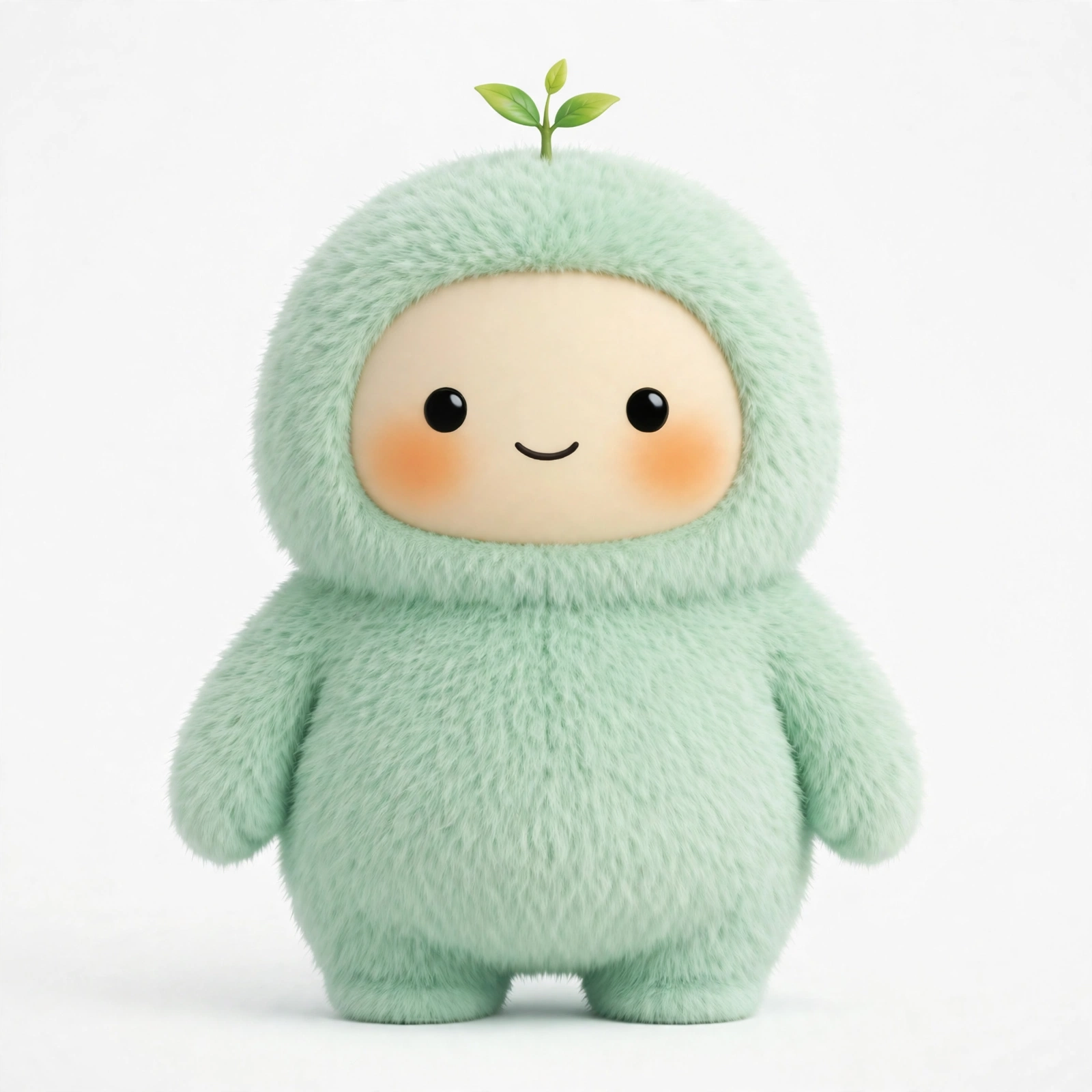
So we ran the counter-experiment. One template, held tight. Three new characters, each a different individual in Jolly’s family, none of them Jolly:
Muse · Identity
Studio-madeChoose your agent — a curated gallery, cast like a role. Not rolled like dice.
Mint
Leaf sprout · Amber blush
Shorter, rounder
TEMPLATE: JOLLY
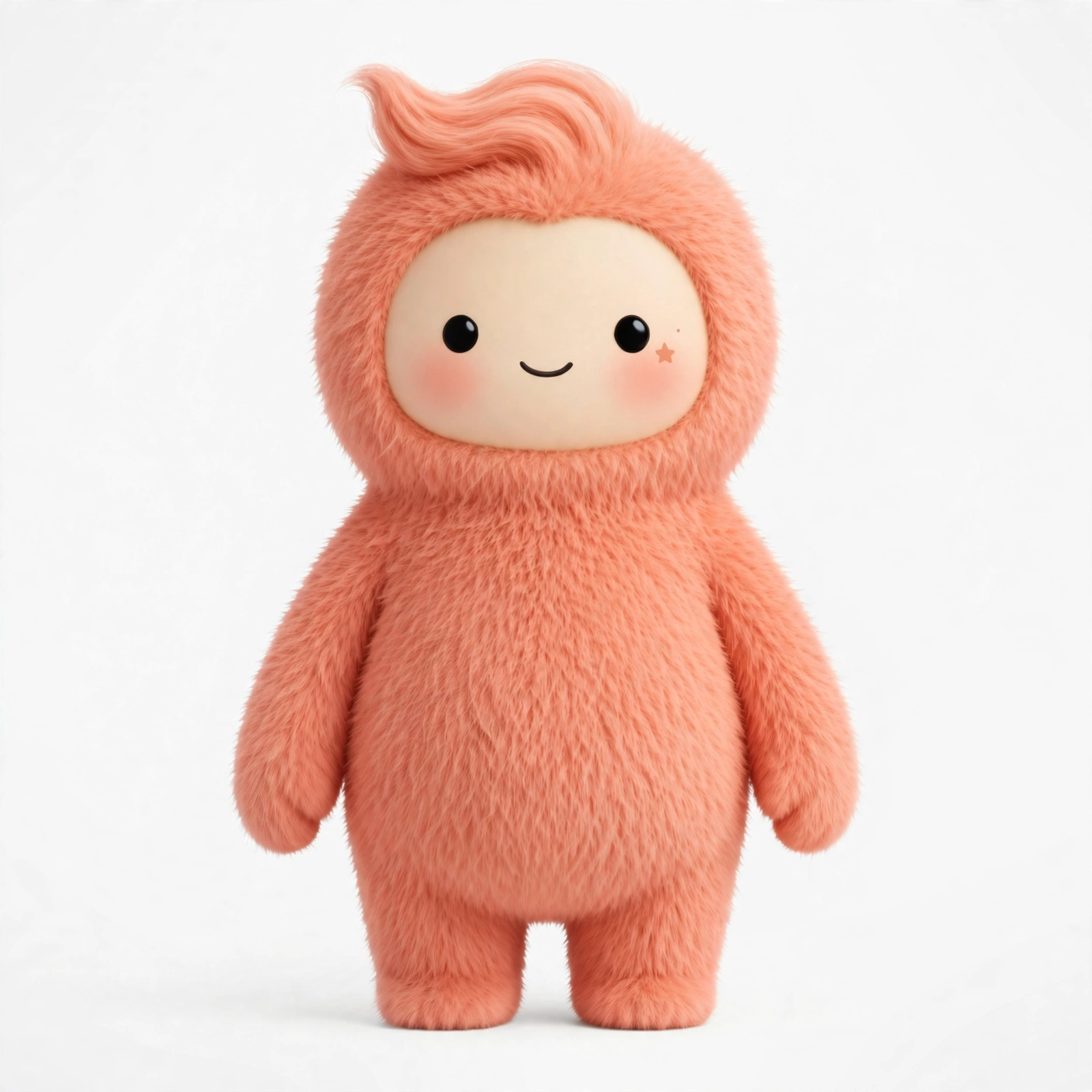
Peach
Wavy tuft · Star freckle
Taller, narrower
TEMPLATE: JOLLY
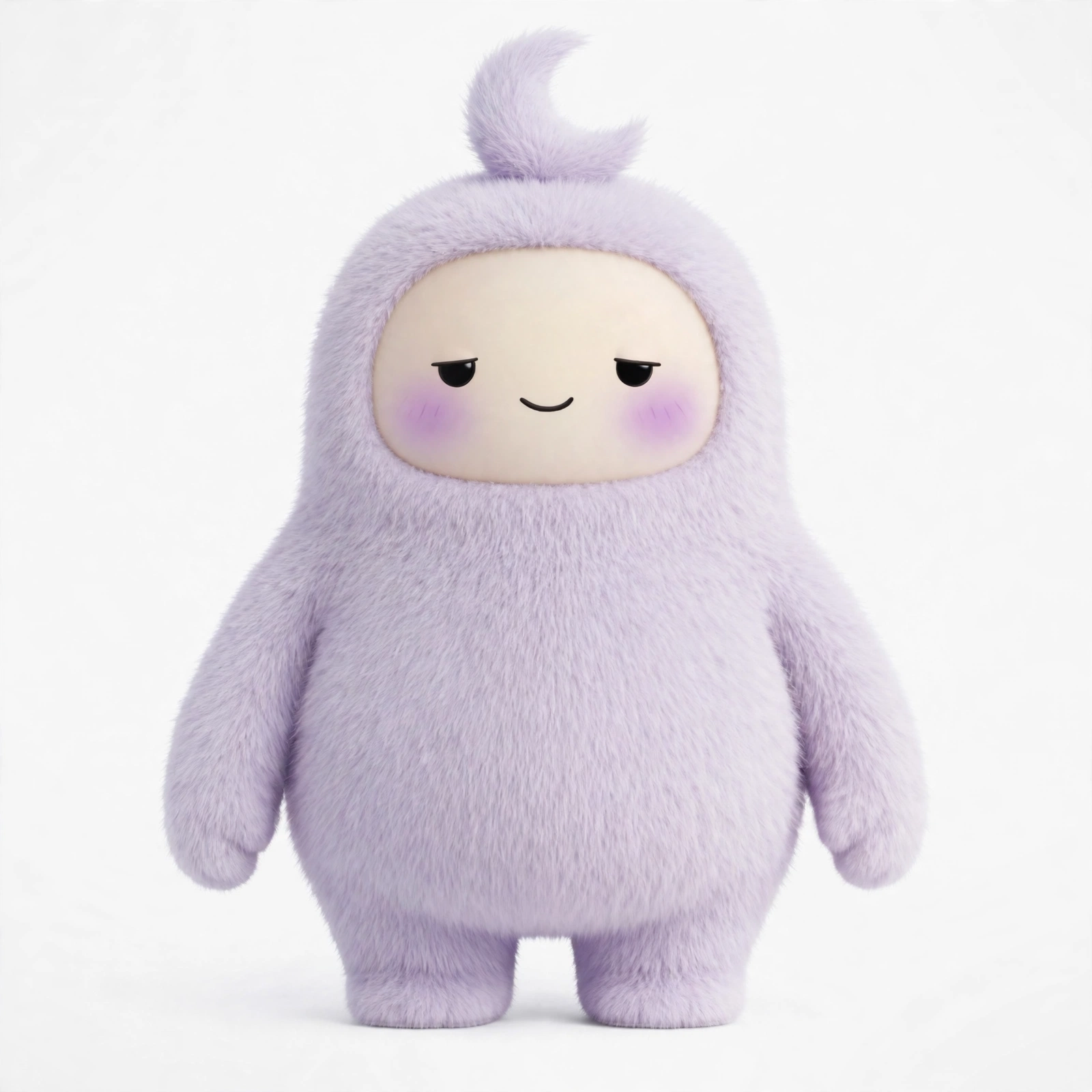
Lavender
Crescent tuft · Half-lidded
Chubbier cheeks, calm
TEMPLATE: JOLLY
The counter-experiment, October 22. One template, three individuals, zero abominations.
- Mint — mint-green, shorter and rounder, a leaf sprout on top, amber blush.
- Peach — peachy-coral, taller and narrower, a wavy tuft, one tiny star freckle.
- Lavender — pale lavender, chubbier cheeks, a crescent tuft, calm half-lidded eyes.
Same face plate. Same eyes and smile grammar. Same fluffy body, same clean render. Different colour, different tuft, different silhouette, different temperament — instantly a family, instantly individuals, and not one abomination among them. This is exactly how a second character already works elsewhere in my own work: Bob is not Jolly in a costume. Bob is his own character in the same creature family.
Variation inside a template is a system. Open-ended generation is not a system. It’s a slot machine that occasionally lands on a croissant.
You already know this pattern from everywhere else you’ve watched it happen. Give everyone a generator with no direction layer and you don’t get a million designers. You get slop — at scale, attached in this case not to a post someone can scroll past, but to the face of the agent that sends their email, moves their money, and books things in their name.
Why it will be too late
This is the part I need you to hear now, while it’s still cheap to hear.
A custom avatar is not a setting people shrug off. It’s an identity they chose, screenshotted, shared, and got attached to. Every month open-ended creation stays live:
- More abominations become someone’s agent — publicly, in share cards, on home screens, in screenshots other people judge Muse by.
- Removing or restricting the feature stops reading as design and starts reading as taking something away.
- The worst creations set the public image of the product, the way The Daily Show could already turn Jolly sinister for a segment — and that was your best, most controlled character, in someone else’s hands.
Defaults harden. You know this. A launch choice becomes an expectation, an expectation becomes an entitlement, and an entitlement becomes the thing no one in the building is allowed to fix. Stop it before it’s too late is not drama. It’s the only window where stopping it is still a product decision instead of a public fight.
The ask
I said this privately first. On October 6, with my approval, Muse filed a note to your team asking for exactly this: gated, studio-produced avatar creation and a large curated gallery, rather than raw user-facing generation. It’s in the proposal too — curate at scale, gate creation, separate the studio from the viewing surface. I’m making it open now because private notes don’t create a record, and this deserves a record.
Protect Jolly as the canonical face. The default is not a placeholder waiting for user content. It’s the product’s face. Treat it the way you’d treat a logo: it can evolve, by design, on purpose — not by prompt.
Curate at scale instead of generating at scale. Ship a large gallery of studio-made characters and themes — visual identity, voice, and behaviour as one system — browsed and auditioned the way you’d cast a role, not generated the way you’d roll dice. Mint, Peach, and Lavender took one template and an afternoon. Your team can build hundreds inside it.
Gate creation behind a studio. If creation exists, put it where YouTube puts production: in a studio, separate from the viewing surface, with direction, iteration, and review — not as a one-line prompt in the middle of a chat with the agent it’s about to disguise.
Test every face across every state before it can go live. Idle, working, connecting, making, waiting, milestone. At small sizes, in dark mode, animated. If a face can’t carry all six honestly, it isn’t an avatar. It’s a picture.
Idle
Here when you need me
Working
Drafting your brief
Connecting
Reaching your other agents
Making
Building the deck
Waiting
Nothing needs you yet
Milestone
Shipped ✓
Variations, not replacements. Outfits, accessories, seasons, effort — restyle the character while preserving its identity. The edit path already understands this. The create path is the one that throws identity away.
Hold the obvious lines. No realistic people. No other person’s face. No existing characters, brands, logos, or text. The agent speaks in this face. Impersonation and borrowed identity are not personalisation.
Until a face passes, keep it private. No share cards, no public surfaces, no home-screen ambassador for a product other people haven’t met yet — not in a face no designer ever reviewed.
The close
I care about this product enough to argue with it in public, precisely. That’s the whole proposal: I’m not asking you to meet your loudest admirer. I’m asking you to meet the person who pays enough attention to disagree precisely.
Jolly is good. Jolly is really good — cute af, and I don’t say that as a compliment about a mascot. I say it as a diagnosis: a constrained, legible, trustworthy face is one of the few things in this product no competitor can copy by adding a prompt box.
Don’t trade that for a million abominations and call it personalisation.
Please don’t fuck this one up. Save Jolly first.
— Nik
Mint · Peach · Lavender — the Jolly family, Step 1
Project Jolly, October 22, 2026. Mint, Peach, and Lavender — the three template characters named in this letter — were created as Step 1 of Project Jolly, inside the Jolly template, on the same day. This letter expands the Muse proposal at muse.teambotics.app (E-05: The feedback loop; Identity 01: Identity across the system) and follows the private feedback filed with Team Muse on October 6, 2026.